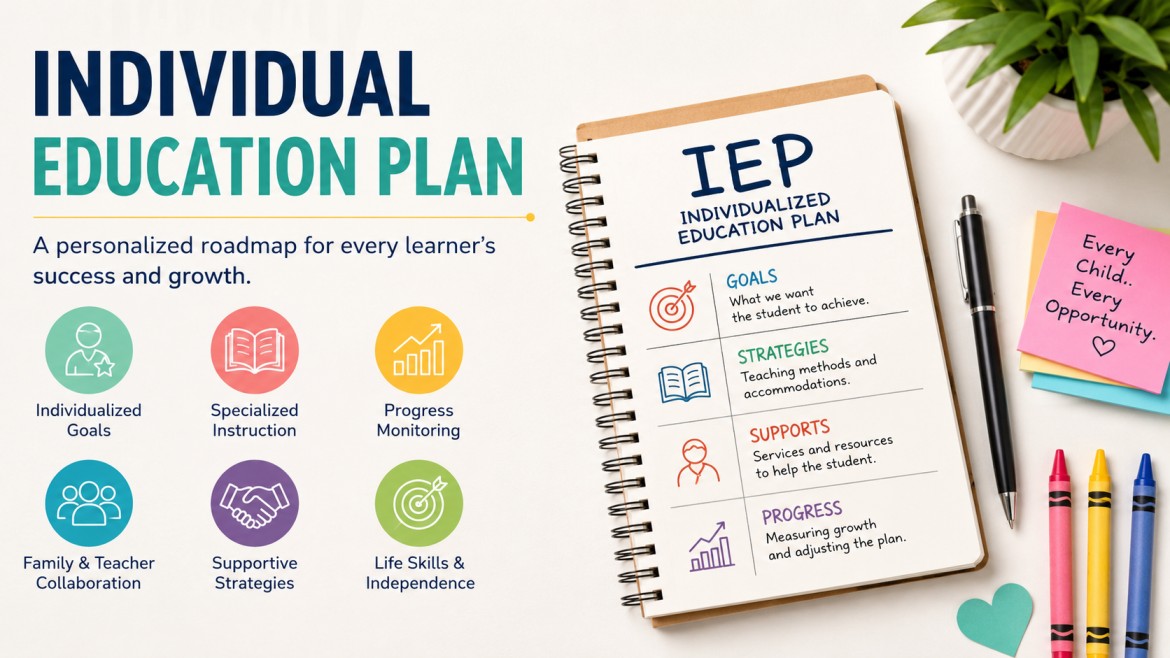
The Individualized Educational Programme (IEP) is specially designed to meet the unique educational and training needs of each child. Since no two children with intellectual disabilities have the same abilities, limitations, or learning requirements, individualized planning becomes essential. Many children may also require support from multiple disciplines such as special education, speech therapy, audiology, psychology, physiotherapy, occupational therapy, and medical services. Therefore, a comprehensive programme must be prepared according to the specific needs of the child.
An IEP includes appropriate support and intervention from different professionals to help the child achieve maximum independence and development. It focuses on the child’s strengths, weaknesses, learning goals, teaching strategies, and support services required for effective learning. The development of an IEP is considered an important part of the diagnostic-prescriptive process, as it helps in planning suitable educational interventions based on assessment findings.
I.E.P. has two sections, Part A and Part B. Part A consists of general information about the child, person initiating the programme and the overall goals for the child. Part B consists of specific programming for a skill or behaviour.
Guidelines for filling up Part A
| Items of Part A | Explanation |
| 1. Name | Give the child’s full name and pet name if any in brackets. |
| 2. Date of birth (age) | Given as in the records. |
| 3. Sex | Mention the child either male, female or any other. |
| 4. Address | Give Present address |
| 5. Mother tongue/ language spoken | It is essential that the child is exposed to one language consistently. Therefore record the details of the child’s mother tongue as well as other language spoken by the child. Circle the mother tongue. |
| 6. Registration Number | Give the number of the registration in the institute/school. |
| 7. Class/ Roll No. | Mention the class or grade of the child with roll no. |
| 8. Date of writing I.E.P. | I.E.P. is generally written on a particular day when the team meets and decides on the programme for the child. Write the date of such a meeting. |
| 9. I.E.P. No. | Each child will have number of I.E.Ps following one after the other. Write the number of the particular I.E.P. |
| 10. Significant information of the person with disability | Includes details on i) the degree of disability ii) associated conditions such as visual, hearing or orthopedic handicap, medical conditions such as epilepsy, hyperkinesis and behaviour problems iii) family background of the child iv) strengths and weakness of the child v) medicine taken if any |
| 11. Goals | Mention the overall goals set for the child after assessment, and the order of priority, if there are more than one goal. |
| 12. Staff Responsible | The name of the staff member, whoever will be responsible for carrying out and coordinating the I.E.P. should be mentioned here. |
Guidelines for filling up Part B
Part B consists of the specific programme for the child with precise instructions to carry out the programme.
| Items | Explanation |
| 13. Skill/ Behaviour | Mention here, the skill on which person with disability/ individual is to be trained, for example, feeding skill, dressing skill or writing skill and so on, If it is a behaviour which i to be modified, mention the name of the behaviour, for example, head banging, eye poking or body rocking and so on. |
| 14. Current level/ Baseline | Write in behavioural terms what exactly the person with disability is able to do in the given skill or behaviour, for example, if the skill is combing hair, the current level can be ‘Picks up comb. holds it appropriately. Places the comb on the head but does not comb the hair in one direction uniformly Cannot make the partition in the hair’. |
| 15. If it is a behaviour | Mention what provokes behaviour, how exactly the person with disability behaves and for how long. |
| 16. Objectives | Mention in behavioural terms what the objective is. Mention the: (a) condition, (b) behaviour, (c) level of performance and (d) duration. To illustrate, an example is given below: (a) When asked (b) the child will (name of the child) indicate to the appropriate picture of the fruit named (c) 8 out of 10 times correctly and (d) in 2 months duration |
| 17. Procedure | Give step by step procedure for meeting the objective. Do not have ambiguous directions. This steps must be specific and clear. Remember to mention the reinforcer to be used and when. |
| 18. Material needed | Write the materials needed for developing the particular skill or improving the particular behaviour. |
| 19. Evaluation | Leave this column blank when I.E.P. is written. After the specific duration when the child is evaluated for progress or problems, fill this column by noting down the observations. This is turn forms the baseline or current level for the next I.E.P. to be written. To qualify the progress of the child, performance may be ranked from 1 to 7 as shown below: Below baseline = 1 No progress = 2 25% progress = 3 50% progress = 4 75% progress = 5 100% progress = 6 100% progress before deadline = 7 Circle the appropriate number. To get the percentage of progress, measure by comparing with the objective, 8 out of 10 times, how many times the child is able to do. Find out the percentage of marks. Skills development in speech and language, motor activities for daily living and academic areas can be written in this format as also the problem behaviours to be corrected. Thus the format is of use for special educators, speech pathologists, psychologists and the physiotherapists. |
| 20. Problems encountered/ remarks | Write here clearly, the problems faced while carrying out the programme which may be specific to the child and the situation. |
Why is an I.E.P. important?
No two children have the same strengths, challenges, learning styles, or pace of development. Some children may require support in communication, academics, behavior, social skills, mobility, self-help skills, or emotional development.
An IEP helps:
- Identify the child’s present level of functioning
- Set realistic and achievable goals
- Provide individualized teaching strategies
- Ensure collaboration among professionals and parents
- Track the child’s progress regularly
- Promote independence and inclusion
It acts as a bridge between assessment findings and classroom intervention.
Who needs an I.E.P.?
An IEP is generally prepared for children with:
- Intellectual disability
- Autism spectrum disorder
- Learning disabilities
- Speech and language disorders
- Hearing impairment
- Visual impairment
- Multiple disabilities
- Developmental delays
- Cerebral palsy and other neurological conditions
Role of parents in I.E.P.
Parents are an essential part of the IEP team. Their observations, concerns, and expectations help professionals understand the child better. Parent involvement also ensures consistency between home and school learning.
Parents can:
- Share information about the child
- Participate in goal setting
- Practice activities at home
- Monitor progress regularly
Role of Teachers and Professionals
The success of an IEP depends on teamwork. Teachers and therapists work together to provide coordinated support to the child.
- Their responsibilities include:
- Communicating with parents
- Conducting assessments
- Planning individualized goals
- Implementing interventions
- Recording progress
Benefits of an I.E.P.
- Personalized learning experience
- Better academic and functional outcomes
- Increased independence
- Improved confidence and self-esteem
- Structured intervention planning
- Enhanced collaboration among professionals and families
Challenges in Implementing IEP
Although IEPs are highly beneficial, certain challenges may arise:
- Lack of trained professionals
- Limited resources
- Large classroom sizes
- Insufficient parent awareness
- Time constraints in regular schools
Despite these challenges, effective planning and collaboration can make IEP implementation successful.
An Individualized Education Programme (IEP) is one of the most valuable tools in special and inclusive education. It recognizes that every child is unique and deserves an education designed according to their individual needs and abilities.
When educators, therapists, and parents work together through an effective IEP, children receive the support they need to learn, grow, and become more independent in life.
An IEP is not simply about addressing difficulties—it is about discovering strengths, creating opportunities, and empowering every child to achieve their fullest potential.