When we talk about learning disability people think it might be dyslexia because it is one of the most widely recognised learning disability. We already aware of signs such as letter reversals, confusion similar-looking letters, difficulty decoding words, weak phonological awareness, slow and inaccurate reading, spelling difficulties, omission or substitution of sounds and letters, poor reading fluency and challenges in understanding written text.
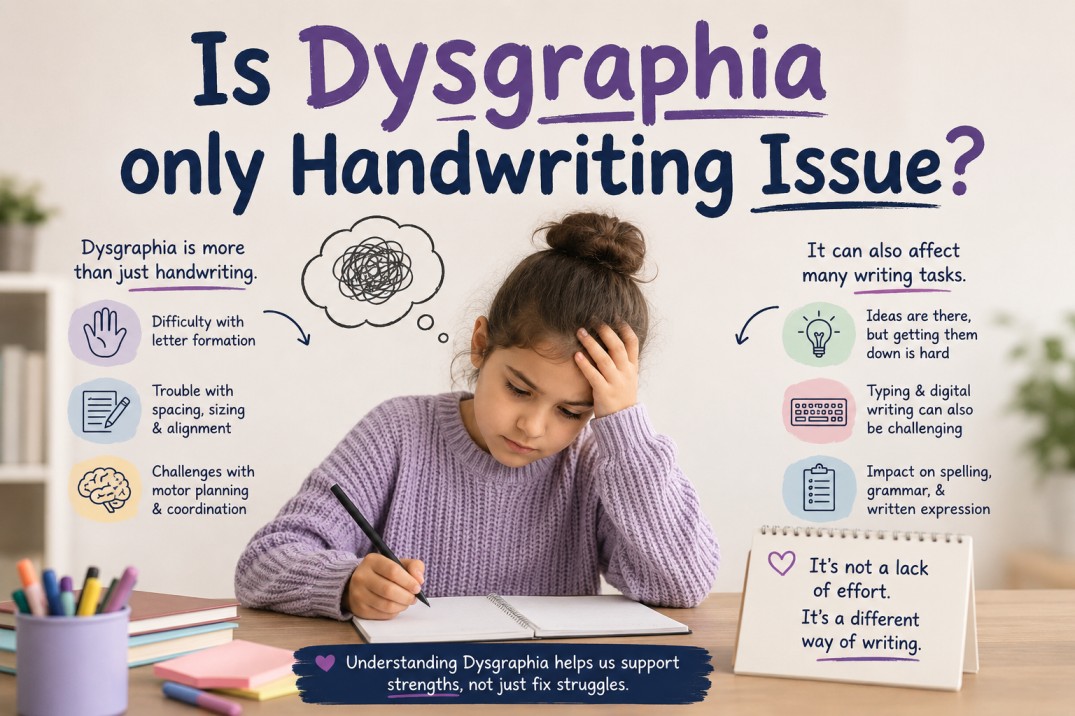
However, when it comes to dysgraphia it is often misunderstood and reduced to a simple handwriting problem. Is dysgraphia only untidy handwriting? If yes, It would not be considered as a learning disability.
Dysgraphia is much more than poor handwriting. It can impact a child’s ability to organize thoughts, retrieve and sequence letters correctly, spell words accurately, maintain appropriate spacing, use grammar and punctuation, and transfer their ideas from mind onto a paper. A child may know the answers, understand the concepts and even verbally can explain them, yet struggle significantly when asked to write it down.
Many people assume writing only requires a pencil and paper. In reality, writing is a highly complex task that requires the coordination of multiple skills, including
- Language processing
- Working memory
- Attention
- Motor planning
- Visual-motor integration
- Executive functioning
A difficulty in any of these areas can affect writing performance.
Pre-Requisite Skills for Writing
These are the skills that prepare a child successful writing. They form the foundation upon which writing develops.
- Fine Motor Skills
- Holding and controlling a pencil
- Finger strength and dexterity
- Hand manipulation skills
- Bilateral coordination (using both hands together)
- Postural Control
- Sitting upright comfortably
- Maintaining a stable posture while writing
- Shoulder and arm stability
- Visual Skills
- Visual discrimination (identifying differences between letters and shapes)
- Visual memory (remembering letter forms)
- Visual sequencing
- Figure-ground perception
- Visual-Motor Integration
- Coordinating what the eyes see with hand movements
- Copying shapes, letters, and patterns accurately
- Motor Planning (Praxis)
- Planning and executing movements needed for letter formation
- Remembering the sequence of strokes required to write letters
- Language Skills
- Vocabulary development
- Understanding sentence structure
- Phonological awareness
- Expressive language skills
- Cognitive Skills
- Attention and concentration
- Working memory
- Processing speed
- Organization and sequencing
- Letter Knowledge
- Letter recognition
- Letter-sound correspondence
- Correct letter formation
- Spatial Awareness
- Understanding spacing between letters and words
- Alignment on lines
- Size consistency of letters
- Executive Function Skills
- Planning ideas before writing
- Organizing thoughts
- Self-monitoring and editing written work
The next time you ask a child to write, pause for a moment and ask yourself: Is the child truly ready to write? Before expecting a child to write letters, words, or sentences, ensure that they have developed the essential pre-requisite skills for writing:
- Can the child hold and control a pencil effectively?
- Does the child have adequate finger strength and fine motor skills?
- Can the child coordinate eye and hand movements?
- Does the child recognize letters and their sounds?
- Can the child remember and sequence information?
- Does the child have sufficient attention and concentration?
- Can the child understand and express ideas through language?
- Is the child able to plan, organize, and monitor their work?
- Does the child understand spacing, directionality, and positioning on paper?
Understanding Dysgraphia
Dysgraphia is a specific learning disability that affects a person’s ability to produce written language effectively. It impacts handwriting, written expression, and the ability to organize thoughts on paper. The individual with dysgraphia may have average and above average intelligence.
Common Signs of Dysgraphia
- Handwriting Difficulties
- Poor letter formation Inconsistent letter size
- Irregular spacing between letters and words
- Difficulty staying on the line
- Slow and effortful writing
- Written Expression Difficulties
- Difficulty organizing ideas in writing
- Shorter written responses than expected
- Incomplete sentences
- Problems with grammar and punctuation
- Physical Signs
- Unusual pencil grip
- Hand fatigue while writing
- Complaints of pain during writing tasks
- Avoidance of writing activities
Why Does Dysgraphia Occur?
Writing requires the integration of many skills:
- Fine motor skills
- Visual-motor integration
- Language skills
- Working memory
- Attention
- Executive functioning
When there are difficulties in one or more of these areas, writing can become challenging.
How Dysgraphia Appears in the Classroom
When a writing task is given, a child with dysgraphia may experience difficulties at multiple stages of the writing process. The child may know the answer, understand the topic, and have ideas to share, but putting those ideas onto paper can be extremely challenging.
A child with dysgraphia may:
- Take a long time to begin writing.
- Struggle to form letters accurately and consistently.
- Write slowly and with considerable effort.
- Have difficulty remembering how to spell familiar words.
- Lose track of ideas while focusing on handwriting or spelling.
- Produce shorter written responses than their actual knowledge would suggest.
- Make frequent spelling, punctuation, and grammatical errors.
- Have difficulty organizing thoughts into sentences and paragraphs.
- Erase repeatedly or make numerous corrections.
- Experience hand fatigue, discomfort, or frustration during writing tasks.
- Avoid writing activities whenever possible.
When writing becomes a battle, remember that the child’s ideas may be far greater than what appears on the page.
Types of Dysgraphia
Dyslexic Dysgraphia
Dyslexic Dysgraphia is a form of dysgraphia that is closely associated with difficulties in language processing and is often seen in individuals with dyslexia. Children with dyslexic dysgraphia experience challenges with spelling, written expression, and the organization of written language. Their handwriting may be legible or illegible, but spelling errors and written language difficulties are typically much more prominent than motor difficulties.
Motor Dysgraphia
Motor dysgraphia is a type of dysgraphia in which a child experiences difficulty with writing due to poor fine motor skills, weak motor coordination, or challenges in controlling hand movements. The child knows what they want to write and may have age-appropriate language and spelling skills, but the physical act of writing is difficult and effortful.
Spatial Dysgraphia
Spatial Dysgraphia is a type of dysgraphia characterized by difficulties with visual-spatial processing and spatial organization during writing. Children with spatial dysgraphia generally know what they want to write and may have adequate language, spelling, and motor skills, but they struggle to organize letters, words, numbers, and written work appropriately on a page.
Phonological Dysgraphia
Phonological Dysgraphia is a type of dysgraphia in which a child experiences difficulty writing words because of weaknesses in phonological processing—the ability to identify, remember, and manipulate the sounds within spoken language. Children with phonological dysgraphia often struggle to convert sounds (phonemes) into written letters or letter combinations (graphemes), making spelling particularly challenging.
Lexical Dysgraphia
Lexical Dysgraphia is a type of dysgraphia in which a child has difficulty spelling words that cannot be accurately spelled by sounding them out. These children struggle to access and retrieve the stored visual memory of correctly spelled words (known as the orthographic lexicon). As a result, they often rely heavily on phonetic spelling, even for familiar irregular words.