
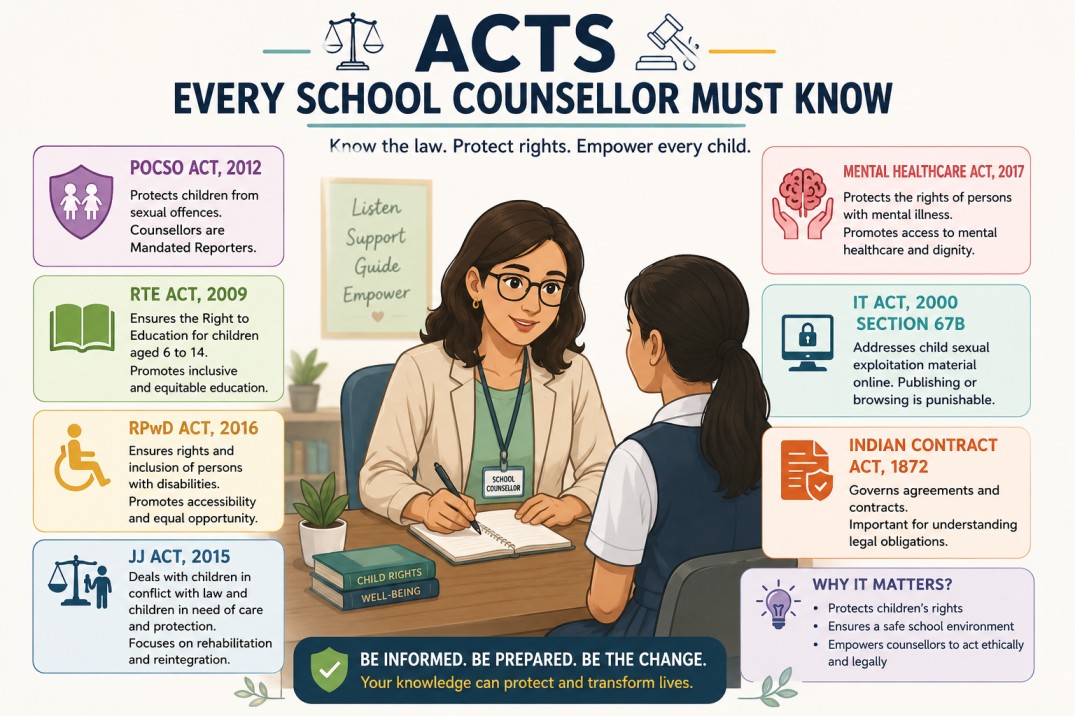
POCSO Act, 2012
The Protection of Children from Sexual Offences (POCSO) Act, 2012 is a law enacted by the Government of India to protect children from sexual abuse, sexual harassment, and exploitation. It provides a child-friendly legal framework for reporting, investigating, and prosecuting offences against children.
Under the POCSO Act, a child is any person below the age of 18 years.
Protection of Children from Sexual Offences Act, 2012
Why Was the POCSO Act Introduced?
Before POCSO, there was no comprehensive law specifically addressing sexual offences against children. The Act was introduced to:
- Protect children from sexual abuse and exploitation.
- Ensure child-friendly reporting and legal procedures.
- Provide speedy justice through Special Courts.
- Safeguard the rights and dignity of children during legal proceedings.
Features of the POCSO Act
1. Gender-Neutral Law
The Act protects all children, regardless of gender. Both boys and girls can be victims, and any person can be an offender.
2. Child-Friendly Procedures
The law ensures that:
- The child is treated with dignity and sensitivity.
- Statements are recorded in a comfortable environment.
- Repeated questioning of the child is minimized.
- The identity of the child is kept confidential.
3. Special Courts
Special Courts are established to conduct speedy trials and reduce trauma for the child.
4. Mandatory Reporting
Any person who suspects or becomes aware of sexual abuse against a child is legally required to report it to the police or appropriate authorities.
Failure to report may attract punishment under the Act.
Types of Offences Covered Under POCSO
1. Penetrative Sexual Assault
When a person sexually penetrates a child using any body part or object.
2. Aggravated Penetrative Sexual Assault
A more serious form of assault involving:
- Persons in positions of trust or authority.
- Repeated abuse.
- Abuse causing severe injury.
- Abuse of children with disabilities.
3. Sexual Assault
Physical sexual contact without penetration and with sexual intent.
4. Sexual Harassment
Includes:
- Making sexually inappropriate comments.
- Showing pornography to a child.
- Repeated unwanted sexual gestures or communication.
5. Use of Children for Pornographic Purposes
Creating, distributing, possessing, or using child sexual abuse material is punishable under the Act.
Responsibilities of Teachers
Teachers play an important role in identifying and reporting abuse.
Warning Signs That May Indicate Abuse
Physical Signs
- Unexplained injuries.
- Difficulty walking or sitting.
- Frequent complaints of pain.
Emotional Signs
- Anxiety or fearfulness.
- Sudden withdrawal from activities.
- Depression or mood changes.
Behavioral Signs
- Age-inappropriate sexual knowledge.
- Aggressive behavior.
- Decline in academic performance.
- Reluctance to go home or be with certain individuals.
What Should a Teacher Do?
| If a child Discloses Abuse: | Avoid: |
| Stay calm and listen carefully | Blaming the child |
| Believe the child | Asking leading questions |
| Thank the child for sharing | Making promises you cannot keep |
| Reassure the child that help is available | Confronting the alleged offender yourself |
| Report the matter immediately according to school and legal procedures | Giving vocab to the child |
Rights of the Child Under POCSO
The child has the right to:
- Protection and safety.
- Privacy and confidentiality.
- Medical care when required.
- Psychological support and counseling.
- Participation in legal proceedings in a child-friendly manner.
- Compensation and rehabilitation where applicable.
POCSO and Children with Disabilities
Children with disabilities may be at greater risk of abuse due to communication barriers, dependency on caregivers, or limited awareness of personal safety.
The Act provides additional safeguards to ensure:
- Accessible communication methods.
- Appropriate support persons.
- Child-friendly and disability-sensitive procedures.
Safe Touch and Unsafe Touch
Safe Touch
A touch that makes a child feel cared for, protected, and comfortable.
Examples:
- A parent helping a child cross the road.
- A doctor examining a child with permission and in the presence of a trusted adult.
Unsafe Touch
A touch that makes a child uncomfortable, scared, confused, or hurt, especially involving private body parts.
Children should be taught:
- Their body belongs to them.
- They can say “No.”
- They should tell a trusted adult if something feels wrong.
The POCSO Act is an important legal safeguard that protects children from sexual offences and ensures their rights, dignity, and well-being. Teachers, parents, caregivers, and communities all share the responsibility of creating safe environments where children feel protected, respected, and empowered to speak up.
RTE Act, 2009
The Right of Children to Free and Compulsory Education Act, 2009, commonly known as the RTE Act, 2009, is a landmark law that ensures every child in India has access to quality elementary education. It came into force on 1 April 2010, making education a fundamental right for children.
The Act was enacted under Article 21A of the Constitution of India, which guarantees free and compulsory education to children.
What is the RTE Act?
The Right to Education Act provides free and compulsory education to all children aged 6 to 14 years in India.
Free Education Means:
- No child should be required to pay fees or charges that prevent them from completing elementary education.
- Essential educational facilities must be provided without financial burden.
Compulsory Education Means:
- The government is responsible for ensuring that every child is enrolled, attends school, and completes elementary education.
Objectives of the RTE Act
The Act aims to:
- Ensure universal access to education.
- Reduce educational inequality.
- Promote inclusive education.
- Improve the quality of elementary education.
- Prevent discrimination in schools.
- Ensure that every child receives a child-centered education.
Features of the RTE Act
1. Education as a Fundamental Right
Every child between 6 and 14 years of age has a legal right to free and compulsory education.
2. No Denial of Admission
A child cannot be denied admission due to:
- Lack of age proof.
- Late admission.
- Previous educational background.
3. Age-Appropriate Admission
Children who have never attended school or have dropped out should be admitted to an age-appropriate class and provided special training to help them catch up.
4. No Capitation Fee
Schools cannot demand donations or capitation fees during admission.
5. No Screening Procedure
Schools are prohibited from conducting interviews or tests for admission of children or parents.
6. Neighbourhood Schools
Governments are required to establish schools within a reasonable distance of children’s homes.
7. Continuous and Comprehensive Development
The Act emphasizes child-friendly and activity-based learning approaches that support overall development.
25% Reservation in Private Schools
One of the most significant provisions of the RTE Act is the reservation of 25% of seats in entry-level classes in private unaided schools for children from economically weaker sections and disadvantaged groups.
The government reimburses schools according to prescribed norms.
Provisions Related to Teachers
Teacher Qualifications
Teachers must possess prescribed professional qualifications.
Duties of Teachers
Teachers should:
- Maintain regular attendance.
- Complete curriculum within the prescribed time.
- Assess children’s learning needs.
- Provide additional support when necessary.
- Communicate with parents regarding progress.
Prohibition of Private Tuition
Teachers employed in schools are generally prohibited from engaging in private tuition activities.
School Infrastructure Norms
Schools are expected to provide:
- Safe classrooms.
- Drinking water facilities.
- Separate toilets for boys and girls.
- Playground facilities.
- Boundary walls or fencing.
- Library resources.
- Adequate teaching-learning materials.
Inclusion of Children with Disabilities
The RTE Act supports the educational rights of children with disabilities and promotes inclusive education.
Schools are encouraged to:
- Provide barrier-free access.
- Make reasonable accommodations.
- Ensure participation in classroom activities.
- Create supportive learning environments.
The Act works alongside the Rights of Persons with Disabilities Act, 2016 to strengthen educational opportunities for children with disabilities.
Prohibition of Physical Punishment
The Act strictly prohibits:
- Physical punishment.
- Mental harassment.
- Humiliation.
- Discriminatory treatment.
Schools must maintain a safe and respectful environment for all children.
Responsibilities of Parents
Parents and guardians should:
- Ensure regular school attendance.
- Support children’s learning.
- Maintain communication with teachers.
- Encourage positive attitudes toward education.
Responsibilities of Government
The government is responsible for:
- Establishing sufficient schools.
- Recruiting qualified teachers.
- Providing educational resources.
- Monitoring educational quality.
- Supporting disadvantaged groups.
Importance of the RTE Act
The RTE Act has:
- Increased school enrolment.
- Improved access to education for marginalized groups.
- Encouraged inclusive educational practices.
- Reduced barriers to elementary education.
- Strengthened children’s educational rights.
Challenges in Implementation
Some challenges include:
- Teacher shortages.
- Infrastructure gaps.
- Learning achievement concerns.
- School dropout rates in some regions.
- Ensuring effective inclusion of children with disabilities.
The Right to Education Act, 2009, is a transformative step toward ensuring that every child has access to education, regardless of social or economic background. It recognizes education as a fundamental right and places responsibility on families, schools, communities, and governments to ensure that no child is left behind.
JJ Act, 2015
The Juvenile Justice (Care and Protection of Children) Act, 2015, commonly known as the JJ Act, 2015, is the primary law in India for the care, protection, development, treatment, and rehabilitation of children who are in need of care and protection, as well as children who come into conflict with the law.
The Act replaced the earlier Juvenile Justice Act, 2000, and aims to ensure that the best interests of children are protected while promoting their rehabilitation and social reintegration.
Objectives of the JJ Act, 2015
The Act aims to:
- Protect the rights of children.
- Provide care, protection, and rehabilitation to vulnerable children.
- Ensure child-friendly approaches in legal proceedings.
- Promote adoption of orphaned, abandoned, and surrendered children.
- Rehabilitate children who come into conflict with the law.
- Ensure the child’s best interests are always prioritized.
Who is a Child Under the JJ Act?
A child is any person below the age of 18 years.
The Act categorizes children into two groups:
1. Child in Conflict with Law (CCL)
A child alleged or found to have committed an offence while below 18 years of age.
2. Child in Need of Care and Protection (CNCP)
Children who are:
- Orphaned.
- Abandoned.
- Missing.
- Homeless.
- Victims of abuse or neglect.
- Victims of trafficking.
- Living in unsafe environments.
- Children affected by disasters or emergencies.
Principles of the JJ Act
The Act is based on several child-rights principles, including:
Principle of Best Interest
Every decision should promote the child’s well-being and development.
Principle of Dignity and Worth
Every child must be treated with respect and dignity.
Principle of Participation
Children should be given opportunities to express their views.
Principle of Family Responsibility
Families should be supported in caring for children whenever possible.
Principle of Institutionalization as a Last Resort
Children should remain in family and community-based settings whenever feasible.
Juvenile Justice Board (JJB)
The Juvenile Justice Board deals with children in conflict with the law.
Functions of the JJB
- Conduct inquiries regarding offences committed by children.
- Ensure child-friendly legal procedures.
- Decide rehabilitation measures.
- Protect the rights of children during proceedings.
The Board generally consists of:
- One Judicial Magistrate.
- Two social workers, including at least one woman
Child Welfare Committee (CWC)
The Child Welfare Committee is responsible for children in need of care and protection.
Functions of the CWC
- Receive and assess cases involving vulnerable children.
- Provide immediate care and protection.
- Arrange rehabilitation services.
- Restore children to families when appropriate.
- Facilitate foster care, sponsorship, or adoption.
Types of Offences Under the Act
For children in conflict with the law, offences are classified as:
Petty Offences
Offences with a maximum punishment of up to 3 years.
Serious Offences
Offences with punishment between 3 and 7 years.
Heinous Offences
Offences with punishment of 7 years or more.
Rehabilitation and Social Reintegration
The Act emphasizes rehabilitation rather than punishment.
Rehabilitation Measures Include:
- Counseling.
- Education.
- Skill development.
- Vocational training.
- Foster care.
- Sponsorship.
- Adoption.
- After-care services.
The goal is to help children become productive and responsible members of society.
Adoption Provisions
The Act strengthened adoption procedures in India.
Adoption May Be Available For:
- Orphaned children.
- Abandoned children.
- Surrendered children.
The process is regulated through the Central Adoption Resource Authority (CARA).
Foster Care
Foster care allows a child to be placed with a family when biological family care is temporarily unavailable.
Benefits include:
- Family-based care.
- Emotional support.
- Better social development.
- Reduced institutionalization.
Responsibilities of Schools and Teachers
Teachers should:
- Identify signs of abuse, neglect, or exploitation.
- Report concerns to appropriate authorities.
- Create safe and inclusive learning environments.
- Support children’s emotional and educational needs.
- Collaborate with parents and child protection agencies.
Rights of Children Under the JJ Act
Every child has the right to:
- Protection from abuse and neglect.
- Education.
- Healthcare.
- Dignity and respect.
- Participation in decisions affecting them.
- Rehabilitation and reintegration.
- A safe and supportive environment.
Importance of the JJ Act
The JJ Act is important because it:
- Protects vulnerable children.
- Promotes rehabilitation over punishment.
- Strengthens child protection systems.
- Encourages family-based care.
- Supports adoption and foster care.
- Upholds children’s rights and dignity.
JJ Act and Inclusive Education
For educators and special educators, the JJ Act is particularly important because many children with disabilities, children facing neglect, or children living in vulnerable circumstances may require protection and support services.
Schools play a crucial role in:
- Early identification of risk factors.
- Child protection reporting.
- Emotional support.
- Educational inclusion.
- Coordination with child welfare agencies.
The Juvenile Justice (Care and Protection of Children) Act, 2015, is a comprehensive child protection law that focuses on the care, safety, rehabilitation, and overall development of children. It recognizes that every child deserves protection, opportunities for growth, and a chance to thrive in a safe and supportive environment.
Mental Healthcare Act, 2017
The Mental Healthcare Act, 2017 is a landmark law enacted by the Government of India to protect, promote, and fulfill the rights of persons with mental illness and to ensure access to quality mental healthcare services. The Act replaced the earlier Mental Health Act, 1987, and came into force on 29 May 2018.
Objectives of the Mental Healthcare Act, 2017
The Act aims to:
- Ensure access to mental healthcare services.
- Protect the rights and dignity of persons with mental illness.
- Promote community-based care and rehabilitation.
- Prevent discrimination and stigma.
- Establish mechanisms for monitoring mental healthcare services.
- Support recovery and social inclusion.
What is Mental Illness?
The Act defines mental illness as a substantial disorder of thinking, mood, perception, orientation, or memory that significantly impairs judgment, behavior, reality testing, or the ability to meet the ordinary demands of life. It also includes mental conditions associated with substance abuse.
Features of the Act
1. Right to Access Mental Healthcare
Every person has the right to access affordable, quality, and non-discriminatory mental healthcare services provided or funded by the government. Services should be available in sufficient quantity and accessible geographically.
2. Right to Community Living
Persons with mental illness have the right to live in the community and should not be unnecessarily institutionalized. The Act promotes rehabilitation and inclusion within society.
3. Advance Directive
A person can make an Advance Directive, which specifies:
- How they wish to be treated in the future.
- Treatments they do not wish to receive.
- Preferences regarding mental healthcare decisions during a mental health crisis.
4. Nominated Representative
An individual may appoint a trusted person known as a Nominated Representative to make decisions on their behalf if they are unable to do so during a mental health crisis.
5. Right to Equality and Non-Discrimination
No person with mental illness can be discriminated against on the basis of:
- Gender
- Religion
- Caste
- Disability
- Social status
- Economic background
Mental healthcare services must be provided equally to all.
6. Right to Confidentiality
Mental health information, diagnosis, treatment records, and personal details must remain confidential except in legally permitted circumstances.
7. Right to Information
Persons receiving mental healthcare have the right to:
- Know their diagnosis.
- Understand treatment options.
- Be informed about possible risks and benefits.
- Participate in decisions related to their care.
8. Right to Legal Aid and Complaints
Individuals have the right to seek legal assistance and file complaints if their rights under the Act are violated.
Decriminalization of Suicide Attempts
One of the most important provisions of the Act is that a person attempting suicide is presumed to be under severe stress and should receive care, treatment, and rehabilitation rather than punishment. This marked a significant shift from a punitive approach to a supportive and therapeutic one.
Prohibited Practices
The Act protects individuals from cruel, inhuman, or degrading treatment.
Examples include:
- Chaining.
- Seclusion in isolation.
- Electroconvulsive Therapy (ECT) without anesthesia.
- Certain restrictive and harmful practices.
Mental Health Review Boards
The Act provides for Mental Health Review Board to safeguard the rights of persons with mental illness and review complaints related to treatment, admission, and care.
Importance for Schools and Teachers
Teachers are often among the first adults to notice emotional or behavioral concerns in children.
Teachers Should:
- Promote positive mental health.
- Identify signs of emotional distress.
- Support students experiencing mental health challenges.
- Refer students to appropriate professionals when needed.
- Maintain confidentiality and respect.
- Foster an inclusive and stigma-free environment.
Importance for Parents
Parents should:
- Encourage open communication.
- Recognize emotional and behavioral changes.
- Seek professional help when concerns arise.
- Avoid stigma associated with mental health conditions.
- Support treatment and rehabilitation plans.
Mental Healthcare Act and Inclusive Education
The Act supports inclusive education by emphasizing dignity, equality, and access to appropriate services for individuals with mental health needs. Schools should create environments where students feel safe, supported, and accepted.
Significance of the Act
The Mental Healthcare Act, 2017 is considered one of India’s most progressive rights-based health laws because it:
- Recognizes mental healthcare as a right.
- Protects the autonomy of individuals.
- Promotes dignity and community inclusion.
- Reduces stigma and discrimination.
- Strengthens safeguards against abuse.
The Mental Healthcare Act, 2017 represents a major step toward ensuring that mental health is treated with the same importance as physical health. By focusing on rights, dignity, autonomy, and access to care, the Act helps create a more inclusive and compassionate society.
IT Act, 2000 Section 67B
Section 67B of the Information Technology Act, 2000 is one of India’s most important cyber laws for protecting children in the digital environment. It specifically deals with offences related to child sexual abuse material (CSAM) and the online sexual exploitation of children. The provision was added through the Information Technology (Amendment) Act, 2008.
What is Section 67B?
Section 67B makes it a criminal offence to create, publish, transmit, distribute, seek, download, promote, advertise, or facilitate the circulation of sexually explicit material involving children through electronic means. A child is defined as any person below 18 years of age.
Acts Prohibited Under Section 67B
A person may be punished if they:
1. Publish or Transmit Child Sexual Abuse Material
- Uploading or sharing sexually explicit content involving children.
- Sending such content through social media, messaging apps, websites, or email.
2. Create or Distribute Such Material
- Creating digital images, videos, or text depicting children in obscene, indecent, or sexually explicit situations.
- Advertising, promoting, exchanging, or distributing such material.
3. Online Grooming of Children
- Befriending or manipulating children online for sexual purposes.
- Encouraging children to engage in sexual conversations or activities.
4. Facilitating Online Abuse
- Assisting or enabling the sexual exploitation of children through digital platforms.
5. Recording Child Sexual Abuse
- Recording one’s own abuse of a child or the abuse committed by others.
Punishment Under Section 67B
First Conviction
- Imprisonment up to 5 years
- Fine up to ₹10 lakh
Second or Subsequent Conviction
- Imprisonment up to 7 years
- Fine up to ₹10 lakh
Importance for Schools
Teachers, school counselors, and school leaders should understand Section 67B because children today are increasingly exposed to digital platforms.
Schools should educate students about:
- Safe internet use.
- Online privacy.
- Cyber safety.
- Risks of sharing personal images.
- Reporting suspicious online behavior.
- Recognizing online grooming attempts.
Warning Signs of Possible Online Grooming
A child may:
- Become secretive about online activities.
- Receive gifts or money from unknown individuals.
- Spend excessive time chatting with strangers.
- Hide conversations or social media accounts.
- Show sudden emotional distress related to online interactions.
Responsibilities of Teachers and Parents
Teachers Should:
- Teach cyber safety and digital citizenship.
- Monitor concerns reported by students.
- Report suspected child exploitation to appropriate authorities.
- Work with parents to promote safe technology use.
Parents Should:
- Maintain open communication about internet use.
- Use age-appropriate supervision.
- Teach children never to share personal photos with strangers.
- Encourage children to report uncomfortable online interactions.
Relationship with POCSO Act
Section 67B often works alongside the Protection of Children from Sexual Offences Act, 2012 (POCSO Act). While POCSO addresses sexual offences against children generally, Section 67B specifically addresses offences committed through electronic and digital platforms.
Why Section 67B is Important
The digital world provides opportunities for learning and communication, but it can also expose children to exploitation. Section 67B helps:
- Protect children from online sexual exploitation.
- Deter offenders.
- Promote safer digital environments.
- Support cybercrime investigations.
- Strengthen child protection in the digital age.
Indian Contract Act, 1872
The Indian Contract Act, 1872 is one of the oldest and most important commercial laws in India. It governs agreements and contracts between individuals, organizations, and businesses. The Act defines the rules that make agreements legally enforceable and outlines the rights and obligations of parties entering into contracts.
The Act came into force on 1 September 1872 and continues to form the foundation of contract law in India.
What is a Contract?
According to the Act:
“A contract is an agreement enforceable by law.”
In simple terms, a contract is a legally binding promise between two or more parties.
Example:
A school hires a counselor and both parties agree on duties, salary, and working conditions. Once accepted by both sides, it becomes a contract.
Essential Elements of a Valid Contract
For a contract to be legally valid, the following elements must be present:
1. Offer and Acceptance
One party makes an offer, and the other party accepts it.
Example:
A school offers employment to a teacher, and the teacher accepts the offer.
2. Free Consent
The agreement must be made voluntarily and without:
- Coercion
- Undue influence
- Fraud
- Misrepresentation
- Mistake
3. Lawful Consideration
Consideration means something of value exchanged between parties.
Example:
A teacher provides teaching services, and the school pays a salary.
4. Competent Parties
The parties entering the contract must:
- Be adults (18 years or above in most cases)
- Be of sound mind
- Not be disqualified by law
5. Lawful Object
The purpose of the contract must be legal.
A contract involving illegal activities is void.
6. Intention to Create Legal Relations
The parties must intend for the agreement to have legal consequences.
Types of Contracts
Valid Contract
A legally enforceable agreement fulfilling all legal requirements.
Void Contract
A contract that is not enforceable by law.
Voidable Contract
A contract that may be cancelled by one of the parties due to factors such as fraud or coercion.
Express Contract
Terms are clearly stated verbally or in writing.
Implied Contract
Formed through actions and conduct rather than explicit words.
Breach of Contract
A breach occurs when one party fails to fulfill their contractual obligations.
Example:
A service provider accepts payment from a school but fails to deliver the agreed services.
Remedies for Breach of Contract
The affected party may seek:
Compensation (Damages)
Financial compensation for losses suffered.
Specific Performance
A court order directing a party to fulfill contractual obligations.
Injunction
A court order preventing a party from doing something that violates the contract.
Importance for Schools and Educational Institutions
Educational institutions regularly enter into contracts involving:
- Teacher employment agreements
- School transportation services
- Building maintenance contracts
- Vendor and supplier agreements
- Consultancy services
- Training and workshop arrangements
Understanding contract law helps schools avoid disputes and ensure accountability.
Relevance for School Counselors and Educators
Although counselors and teachers are not usually legal professionals, they may encounter contracts related to:
- Employment
- Consultancy assignments
- Professional training programs
- Content development projects
- Online educational services
Basic knowledge of contract law helps professionals understand their rights and responsibilities.
Important Principle: Minors and Contracts
One key provision is that a minor (a person below 18 years of age) cannot enter into a legally enforceable contract.
This is particularly relevant in schools because agreements signed solely by students may not have legal validity without the involvement of parents or guardians.
Significance of the Indian Contract Act
The Act:
- Creates trust and certainty in transactions.
- Promotes fairness in agreements.
- Protects the rights of parties.
- Facilitates business and professional relationships.
- Provides legal remedies in case of disputes.
The Indian Contract Act, 1872 provides the legal framework that governs agreements and contracts in India. Whether in business, education, employment, or professional services, understanding the basics of contract law helps individuals and organizations enter agreements responsibly and protect their legal interests.
RPwD Act, 2016
The Rights of Persons with Disabilities Act, 2016, commonly known as the RPwD Act, 2016, is a landmark legislation that protects and promotes the rights of persons with disabilities in India. It replaced the Persons with Disabilities (Equal Opportunities, Protection of Rights and Full Participation) Act, 1995 and aligns Indian law with the principles of the United Nations Convention on the Rights of Persons with Disabilities (UNCRPD).
The Act came into force on 19 April 2017 and emphasizes equality, dignity, non-discrimination, accessibility, and inclusion.
Objectives of the RPwD Act, 2016
The Act aims to:
- Protect the rights and dignity of persons with disabilities.
- Ensure equality and non-discrimination.
- Promote inclusion in education, employment, and society.
- Improve accessibility in physical and digital environments.
- Encourage independent living and community participation.
- Provide legal safeguards against abuse and exploitation.
Who is a Person with Disability?
The Act defines a person with disability as someone who has a long-term physical, mental, intellectual, or sensory impairment which, in interaction with barriers, may hinder their full and effective participation in society on an equal basis with others.
Expansion of Recognized Disabilities
One of the most significant features of the RPwD Act is the increase in the number of recognized disabilities from 7 to 21 categories.
Some Recognized Disabilities Include:
- Blindness
- Low Vision
- Deafness
- Hard of Hearing
- Locomotor Disability
- Cerebral Palsy
- Autism Spectrum Disorder
- Intellectual Disability
- Specific Learning Disabilities
- Mental Illness
- Multiple Sclerosis
- Parkinson’s Disease
- Muscular Dystrophy
- Thalassemia
- Hemophilia
- Sickle Cell Disease
- Multiple Disabilities
For educators, the inclusion of Specific Learning Disabilities (SLD) such as dyslexia, dysgraphia, and dyscalculia is particularly important.
Key Rights Under the RPwD Act
1. Right to Equality and Non-Discrimination
Persons with disabilities have the right to equal opportunities and protection against discrimination in all areas of life.
2. Right to Education
Children with disabilities have the right to inclusive education.
Educational institutions must:
- Ensure accessibility to learning materials and environments.
- Admit students without discrimination.
- Provide reasonable accommodation.
- Offer necessary support services.
3. Right to Accessibility
The Act requires accessibility in:
Physical Environment
- Buildings
- Schools
- Transportation systems
- Public spaces
Information and Communication
- Public information systems
- Websites
- Educational materials
- Digital resources
4. Right to Employment
The Act provides reservation and equal employment opportunities for persons with disabilities.
Government establishments are required to reserve 4% of vacancies for eligible persons with benchmark disabilities.
5. Protection from Abuse and Exploitation
Persons with disabilities must be protected from:
- Abuse
- Violence
- Neglect
- Exploitation
Appropriate authorities must take action when violations occur.
Benchmark Disability
A person with 40% or more disability, as certified by a competent authority, is considered a person with benchmark disability and may be eligible for various benefits and reservations under the Act.
Reservation Provisions
The Act provides:
Education
- Reservation in higher educational institutions.
Employment
- Reservation in government jobs.
Skill Development
Opportunities for vocational and professional training.
Inclusive Education Under the RPwD Act
The Act strongly promotes inclusive education.
Schools should:
- Foster acceptance and inclusion.
- Provide barrier-free access.
- Use appropriate teaching strategies.
- Adapt curriculum when necessary.
- Provide assistive technology.
- Support participation in all school activities.
Responsibilities of Schools and Teachers
Teachers play a crucial role in implementing the Act.
Teachers Should:
- Identify learning needs early.
- Provide accommodations and support.
- Use inclusive teaching methods.
- Collaborate with parents and specialists.
- Promote positive attitudes toward disability.
- Prevent bullying and discrimination.
Schools Should:
- Create supportive learning environments.
- Develop inclusive policies.
- Ensure accessibility.
- Train staff on disability awareness.
Role of Parents
Parents should:
- Encourage independence and self-advocacy.
- Advocate for their child’s rights.
- Participate in educational planning.
- Collaborate with schools.
Importance for Special Educators
For special educators, the RPwD Act provides the legal foundation for:
- Protection of children’s educational rights.
- Inclusive education practices.
- Individualized support services.
- Educational accommodations.
- Recognition of learning disabilities.
Significance of the RPwD Act
The Act represents a shift from a welfare-based approach to a rights-based approach.
It recognizes that disability is not merely a medical condition but also the result of societal and environmental barriers that restrict participation.
The Rights of Persons with Disabilities Act, 2016 is a transformative law that promotes inclusion, accessibility, equality, and dignity for persons with disabilities. It empowers individuals to participate fully in education, employment, and community life while placing responsibility on society to remove barriers and create inclusive environments.
Quick Summary
| Act | Year | Main Purpose | Key Beneficiaries | Important Provisions |
|---|---|---|---|---|
| Right of Children to Free and Compulsory Education Act, 2009 (RTE Act) | 2009 | Ensures free and compulsory education | Children aged 6–14 years | Free education, no capitation fee, no screening test, 25% reservation in private schools, inclusive education |
| Protection of Children from Sexual Offences Act, 2012 (POCSO Act) | 2012 | Protects children from sexual offences | Children below 18 years | Mandatory reporting, child-friendly procedures, Special Courts, protection from sexual abuse and harassment |
| Juvenile Justice (Care and Protection of Children) Act, 2015 (JJ Act) | 2015 | Care, protection, rehabilitation, and adoption of children | Children in conflict with law and children in need of care and protection | Child Welfare Committee (CWC), Juvenile Justice Board (JJB), foster care, adoption, rehabilitation |
| Rights of Persons with Disabilities Act, 2016 (RPwD Act) | 2016 | Protects rights of persons with disabilities | Persons with disabilities | 21 recognized disabilities, inclusive education, accessibility, reservations in education and employment |
| Mental Healthcare Act, 2017 | 2017 | Protects rights of persons with mental illness and ensures access to mental healthcare | Persons with mental illness | Right to mental healthcare, confidentiality, advance directive, decriminalization of suicide attempts |
| Information Technology Act, 2000 – Section 67B | 2000 (Amended 2008) | Protects children from online sexual exploitation and child sexual abuse material | Children using digital platforms | Punishment for sharing, creating, viewing, transmitting CSAM; online grooming offences |
| Indian Contract Act, 1872 | 1872 | Governs agreements and contracts | Individuals, organizations, institutions | Valid contracts, offer and acceptance, free consent, lawful consideration, breach of contract remedies |
| Act | Remember It As |
|---|---|
| RTE Act, 2009 | Every child has a right to education. |
| POCSO Act, 2012 | Protecting children from sexual abuse. |
| JJ Act, 2015 | Protecting and rehabilitating vulnerable children. |
| RPwD Act, 2016 | Ensuring rights and inclusion for persons with disabilities. |
| Mental Healthcare Act, 2017 | Protecting mental health rights and dignity. |
| IT Act Section 67B | Protecting children from online sexual exploitation. |
| Indian Contract Act, 1872 | Making agreements legally enforceable. |
Why Every School Counselor Should Know These Acts
- RTE → Educational rights of children.
- POCSO → Child protection and mandatory reporting.
- JJ Act → Care and rehabilitation of vulnerable children.
- RPwD → Rights and inclusive education for students with disabilities.
- Mental Healthcare Act → Mental health rights and support systems.
- IT Act Section 67B → Cyber safety and online child protection.
- Indian Contract Act → Understanding professional agreements and institutional contracts.




One Response
Very exhaustive work Lavanya. All the Acts are clearly explained.