Madras Developmental Programming System is an adaptive behaviour assessment tool. It is a first comprehensive behavioural scale developed in 1975 in Chennai by Prof. P. Jeyachandran and Prof. V. Vimala. It can be used for any age, sex and level of disability (mild, moderate, severe or profound).
It includes 18 domains and each domain comprises of 20 items. So, the total number of items are 360 which are sequentially arranged.
Domains
1. Gross Motor Skills
10. Reading
2. Fine Motor Skills
11. Writing
3. Meal Time Activities
12. Numbers
4. Dressing
13. Time
5. Grooming
14. Money
6. Toileting
15. Domestic Activities
7. Receptive Language
16. Community Orientation
8. Expressive Language
17. Recreational, Leisure Time Activities
9. Social Interaction
18. Vocational
Gross Motor Skills
Gross Motor skills are related to abilities of legs, shoulders and body movements.
Hold head erect when in sitting or standing position (body may be supported by a person or prop).
Sits without support.
Rides a bicycle (without training wheels)/ swims.
1. Hold head erect when in sitting or standing position (body may be supported by a person or prop).
2. Holds head up for 5 seconds when lying on stomach to look at an object.
3. Sits without support.
4. Rolls over on flat surface.
5. Moves from lying on stomach to a sitting position.
6. Crawls about a room containing furniture and/ or other people.
7. Stands with support.
8. Pulls self to standing position using person or prop for support.
9. Stands unsupported.
10. Walks 5 feet (may use braces or crutches).
11. Walks upstairs and downstairs putting both feet on each step (may use wall or handrail for support).
12. Pushes or pulls furniture for rearrangement.
13. Runs.
14. Squats.
15. Walks upstairs and downstairs, alternating feet (may use wall or handrail for support).
16. Jumps to cross an obstracle (e.g. dirty water, rubbish, any floor decoration).
17. Stands on tip toe to reach for an object at a height.
18. Walks continuously for a period of 15 minutes.
19. Carries own luggage to bus stand/ station.
20. Rides a bicycle (without training wheels)/ swims.
Fine Motor Skills
Fine motor skills are related to wrists and finger movements of hands.
Uses both hands of the same time, when handling object.
Cuts out a picture involving circular lines using scissors, from a magazine.
Threads a medium sized sewing needle within 2 tries.
1. Closes hand around an object placed in hand.
2. Reaches for and grasps objects.
3. Uses both hands at the same time, when handling an object.
4. Picks up small objects using thumb and fingers only.
5. Makes a stack of 3 cans, or tiffin carrier containers or wooden blocks.
6. Uses, a spoon to stir sugar/ salt to mix a drink.
7. Strings three one-inch beads or spools on to a string.
8. Opens the door, operating door knob/ latch/ handle.
9. Screws and unscrews a jar or bottle lid.
10. Carries a filled paper cup without crushing, tipping or spilling.
11. Tears off a perforated sheet.
12. Places key correctly, locks and opens the lock.
13. Pours liquid from a pitcher into a tumbler without spilling.
14. Uses clips and safety pins.
15. Cuts out a picture involving straight lines using scissors, from a magazine or a book.
16. Cuts out a picture involving circular lines using scissors, from a magazine.
17. Folds a letter, fits into an envelope, applies gum to seal and puts on a stamp.
18. Cuts/ opens sachets / wrappers and empties into a container.
19. Strikes a safety match to light a candle/ lamp.
20. Threads a medium sized sewing needle within 2 tries.
Meal Time Activities
1. Swallows soft foods that do not require chewing.
2. Drinks without spilling, mouthful from a glass or cup with assistance.
3. Bites required amounts of food items.
4. Differentites between edible and non-edible substances.
5. Picks up dry pieces of food (biscuits) with fingers and puts food in mouth.
6. Chews solid food.
7. Picks up a filled glass and drinks from it without spilling.
8. Uses spoon/ hand to pick up and eat mixed food.
9. Mixes food and eats with little or no spilling (may use fingers/ spoon).
10. Eats foods, (cereal preparations) such as idli, dosai, puri, roti (uses fingers to make bits).
11. Eats, supervised in public places without calling attention to eating behaviour.
12. Eats porridge, payasam (milk pudding), ice cream with little or no spilling.
13. Eats a complete meal with little or no spilling using all normal eating equipment dishes and utensils.
14. After eating, empties plate into a trash can and washes it.
15. Takes appropriate quantities, when food is offered.
16. While eating, politely asks for food to be passed, and waits for others to finish.
17. Makes necessary arrangements for and serves food in a family style setting.
18. Identifies drinking water in a public place and drinks it.
19. Selects the required meal items when a variety of food is available.
20. Orders and eats in a public dining facility.
Dressing
1. Offers little or no resistance while being dressed and undressed.
2. Extends and withdraws arms and legs as required while being dressed and undressed.
3. Removes unbuttoned shirt/ blouse, underpants and outerpants.
4. Removes socks, banians, T-shirts/ dresses, when unfastened.
20. Maintains self, clean, odour- free and groomed.
Toileting
1. Stays dry for two hours.
2. Sits on the toilet for 30 seconds.
3. Eliminates when on the toilet (bowel or bladder).
4. Removes clothing before sitting on the toilet.
5. Goes to the toilet when reminded.
6. Indicates by gestures or words when needed, to use the toilet.
7. Has bowel control giving time enough to reach the toilet (after indicating).
8. Has bladder control giving time enough to reach the toilet (after indicating).
9. Replaces cothing before leaving the toilet.
10. Removes clothing, sits on the toilet, eliminates and replaces clothing after washing (needs help for washing).
11. Goes to the toilet independently.
12. Uses only a urinal or toilet for urination.
13. Flushes the toilet after use.
14. Has bladder control at night.
15. Closes door of toilet for normal privacy in toileting.
16. Cleans self using water after elimination.
17. Obtains help for any toileting problem.
18. Asks the location of the toilet in new situations.
19. Washes and dries hands after toileting.
20. Chooses the correct toilet (Man/ Women) in a public place.
Communication
Communication is simply the act of transferring information from one place/person to another person. It is most important vehicle of human being for their feelings through Verbally, Non Verbally, Written and Visualization.
It has two parts:-
Receptive
Expressive
Receptive Language
1. Turns head towards the source of sound.
2. Responds by eye contact or verbal acknowledgement when name is called.
3. Responds to the instruction ‘Look at me’.
4. Obeys simple instructions such as, ‘come here’ and so on.
5. Stops an activity upon request such as ‘No’ or ‘Stop’.
6. Performs the activity when the word ‘Me’ is used such as ‘Give me the ball’.
7. Identifies different sounds such as bell ringing, hands clapping, whispering, keys jingling.
8. Responds to non verbal communication from others such as frowning, crying, smiling, etc., by returning the gesture or by giving an appropriate verbal response.
9. Points to any common object, such as ball, spoon etc., upon request.
10. Points to 10 body parts such as nose, eyes, mouth etc.
11. Points to pictures of objects in a book upon request.
12. Follows prepositions such as ‘Put the ball into the box’ or ‘Put the broom behind the door’.
13. Avoids dangers when instructed to do so.
14. Follows two-step directions in order such as, ‘Get the ball and close the door’.
15. Follows left and right when instructed.
16. Follows three-step directions in order such as ‘Stand up’, ‘Open the book’ and ‘Move the chair’.
17. Identifies common harmful substances even if not labelled.
18. After listening to a one-page story, indicates ‘Yes’ or ‘No’ to specific questions on it.
19. Follows announcements on TV, Radio, at railway station, bus stand or airport with appropriate responses.
20. Responds to jokes (humorous happenings at home and school), with expressions.
Expressive Language
1. Makes voice sounds.
2. Uses voice sounds to get attention.
3. Says or indicates, ‘Yes’ or ‘No’ in response to questions.
4. Imitates five words heard either singularly or all at once.
5. Says 20 words.
6. Says name when asked.
7. Names common objects when asked, ‘What is this?’
8. Name 10 body parts when asked, ‘What is this?’
9. Uses two-word phrases/ gestures such as, ‘Hello, friend’, ‘Go out’ or ‘Eat biscuit’.
10. Tells/ indicates name and occupation of parents.
11. Communicates address of residence and contact phone number.
12. Expresses feelings, desires or problems in complete sentences such as ‘I am hungry’, verbally/ gesturally.
13. Asks simple questions such as ‘What is this?’ or ‘Why can’t I? verbally/ gesturally.
14. Uses pronouns such as ‘I’, ‘You’, ‘He’, ‘Her’, ‘Me’ or ‘Mine’ in a complete sentence.
15. Speaks in phrases or sentences/ gestures to communicate to some one not familiar with the person.
16. Names/ indicates country, the President, Prime Minister, Chief Minister of the country.
17. Carries on a meaningful conversation with another person(s) for 10 minutes.
18. Describes past events in a logical order.
19. Summarises a T.V./ Radio programme in own words.
20. Discusses current events.
Social Interaction
1. Responds when touched, by reaching towards or moving away.
2. Looks towards or otherwise, indicates, a person in the immediate area.
3. Follows with eyes, a person moving.
4. Plays alone with toys or objects for 2 minutes.
5. Imitates arm movements such as clapping hands or waving goodbye.
6. Identifies by pointing, naming, friends and acquaintances from strangers.
7. Greets others upon meeting, either verbally or with non-verbal friendly gestures.
8. Waits for own turn in a group.
9. Says Please’ and ‘Thank you’ and ‘Sorry’.
10. Receives guests appropriate to acquaintance (differences in the receiving of relatives, strangers, gas/electricity men and so on).
11. Uses items that belong to others, only with their permission.
12. Objects/asks for help if some one uses own belongings without permission.
13. Interacts with members of the opposite sex and members of different age groups (as required by his community).
14. Responds using proper social courtsies on occasions such as festivals, apologizes, offers greeting or compliments as needed.
15. Participates actively in social events by engaging in the same activity as the other members of the group.
16. Manages/asks for help if/when teased or bullied.
17. Receives phone calls/passes on information to the right person when given messages personally or by phone.
18. Shares possessions with others (in classroom, home and community).
19. Participates in group activities taking the role of a leader.
20. Visits neighbours, relatives and friends when required.
Reading
1. Looks at objects presented when seated at a table.
2. Turns the pages of a book, one at a time.
3. Matches 10 pictures with objects.
4. Sorts objects of 3 different shapes.
5. Identifies names, colours (red, yellow, blue and green) when objects with those colours are presented.
6. Sorts pictures of similar and/or familiar objects into the same category eg. animals, people, vehicles, fruits, flowers etc.
7. Reads out functional 3 letter words.
8. Shown 5 pictures sequentially arranged and told a story with them, pictures then jumbled up, arranges them again in sequence.
9. When needed reads the following words and acts accordingly: ‘Stop, Men, Women, Danger, Poison, Exit, Pull, Push, In, Out, Enter.
10. Reads out functional two-word phrases.
11. Using price tags/price markings, identifies cost of purchases.
12. Reads aloud, sentences with five common words.
13. Reads a simple sentence and answers questions about it.
14. Reads a paragraph (5 lines) and answers questions.
15. Uses a menu card to order meals at restaurants.
16. Reads a story to others.
17. Reads for information or entertainment from newspapers, magazines and story books.
18. Reads a simple story silently and states its main idea.
19. Reads out a recipe for cooking.
20. Reads and follows directions with objects to be assembled.
Writing
1. Grasps chalk, pencil or crayon.
2. Scribbles with chalk, pencil or crayon.
3. Grasps chalk, pencil or crayon for writing with thumb, index finger and middle finger.
4. Traces with pencil or crayon along a three-inch straight line.
5. Colours within lines.
6. Copies with a pencil, a vertical, a horizontal or a diagonal line.
6. Rank orders coins and rupee notes in order of value.
7. Exchanges 10p coins for Re 1/-
8. Exchanges 25p coins and 50p coins for Re. 1/-
9. Exchanges 5p coins for Re 1/-
10. Exchanges the correct number of mixed coins for Re. 1/-
11. Exchanges the correct number of mixed coins and rupee notes for Rs. 5/-
12. Uses correct amount of money for machines (weighing machine, telephone)
13. Exchanges the correct number of mixed coins and rupee notes for Rs. 50/-
14. Saves money for a purchase.
15. Counts the change from a purchase of Rs. 5/- or less checking the quantity bought.
16. Gives an adequate amount of money for purchases upto Rs. 20/-checking the quantity bought and counts the change.
17. Counts the change from a purchase upto Rs. 50/- checking the quantity bought.
18. Counts change from a purchase upto Rs. 100/- checking the quantity bought.
19. Selects an item comparing the prices (concept of expensive, cheap).
20. Saves money in a bank account.
Domestic Activities
1. Picks up household trash or litter and places it in a waste basket upon request.
2. Puts away personal items in the proper location upon request.
3. Dusts furniture leaving no dust on flat surfaces.
4. Damp wipes a floor.
5. Folds clothes and puts them in a drawer/cupboard.
6. Makes bed, stretching, spreading, rolling, folding.
7. Sorts vegetable/grocery items bought from market and stores them in respective containers.
8. Sweeps a floor with a broom, picks up sweepings in a dust pan and empties the pan.
9. Washes and dries dishes.
10. Prepares pre-made drinks (like Rasna) when asked.
11. Peels and cuts vegetables and fruits.
12. Operates a grinder, mixie or grinding stone.
13. Puts off the fire or removes cooker, cooking utensil from the fire in time.
14. Assists in simple first aid.
15. When required, uses a weighing machine, measuring tape or measuring cup.
16. Prepares coffee or tea.
17. Washes and dries clothes.
18. Irons clothes.
19. Does simple home repairs (such as sewing on buttons or rejoining broken seams, using needle and thread or machine, uses nail/ hammer, screw driver).
20. Prepares a meal under supervision.
Community Orientation
1.Perform a simple errands within a familiar setting
2. Finds way by self from one place to another within a familiar building
3. Finds way from one building to another in the immediate neighbourbood.
4. Goes to public places in a supervised group without calling unfavourable attention to self.
5. Identifies a policeman, postman, a fireman, conductor of a bus, gas delivery man and telephone serviceman and persons from power supply.
6. Interacts with strangers in public (as the situation warrants).
7. Crosses residential street intersections, looking in both directions and waiting for traffic to clear before crossing.
8. Walks along road that has no sidewalk – maintains left side.
9. Responds appropriately to social ‘kidding’, teasing in public.
10. Moves about freely in his neighbourhood e.g. school, post office, milk booth, market, place of worship.
11. When goes out with a group, maintains the group norms.
12. Obeys signal lights and ‘Walk’ ‘Don’t walk’ signals at light controlled intersections.
13. Goes on foot or bicycle to a familiar place over half a kilometre from residence and returns.
14. Travels independently by public bus/suburban train in a familiar route.
15. Participates in religious activities following rules (Pooja/Prayer).
16. Leaves an awkward public situation that is beyond control and seeks help.
17. Telephones for information or assistance when necessary.
18. Follows directions in terms of east, west, north, south and reaches the destination.
19. Uses community facilities e.g hospital, railway, bus police station and post office.
20. Casts vote.
Recreational, Leisure Time Activities
1. Engages in a leisure-time activity for 5 minutes when materials are given.
2. Plays simple ball games like catching, throwing, bouncing and rolling a ball.
3. Watches TV without disturbing others.
4. Engages in activities such as finger painting/brush painting,
5. Plays indoor games not governed by rules with others.
6. Participates in group singing or dancing (activity or passively).
7. Plays simple outdoor games not governed by rules e.g. Sand play.
8. Plays outdoor games involving simple rules with others.
9. Plays indoor games, governed by simple rules.
10. Watches TV or listens to the radio, tape recorder by selecting a station/channel turning on and off, including use of cassettes.
11. Involves in activities such as playing with pets, or hobbies such as collection of pictures and so on.
12. Participates in outdoor activities, swimming/cycling/walking/playing.
13. Performs art and craft activities such as clay work, leather work or bead work/rangoli/kolam and so on.
14. Initiates self-involvement in a hobby, not including reading or watching TV.
15. Does gardening/makes flower garlands/mango leaf chain for the door.
16. Participates in organised team sports such as cricket, basket ball or volley ball.
17. Uses community recreation facilities for recreation and liesure time activities – theatres, parks and other amusement places.
18. Participates in planning, preparing for parties and so on.
19. Selects books from library for personal reading.
20. Plays a musical instrument/sings (solo).
Vocational
1. Assumes a body position at a task or at play such that both hands are available for use.
2. Participates in a single activity for 10 minutes (if protected from Interference).
3. Performs a single activity under supervision, in a room with people.
4. Assembles two-part objects that fit together in a simple but secure way.
5. Performs an assigned task or activity for half an hour (may need motivation with rewards).
6. Puts away own tools and materials at the end of a task (may need a reminder upto one-half of the time).
7. Stops a task when required.
8. Participates in group work cooperating with the other members of the group.
9. Changes activity without showing discomfort when assigned from one task to a different task.
10. Accepts supervision and criticism.
11. Goes to an assigned area without reminder in a daily routine programme.
12. Undertakes and completes a task in order to receive money.
13. Reads and then follows the notices, memorandums/circulars. If not able to read, asks for assistance and then follows.
14. Reports for work on time.
15. Increases speed of work when told to do so.
16. Follows the sequence of activities in the routine work skill.
17. Indicates if own performances meet the standards set for an activity.
18. Works full time (8 hours).
19. When situation demands, works in a team.
20. Responds to accidents like fire, electricity, injury by informing the concerned people immediately.
Characteristics of MDPS
This assessment tool contains a wide range of behavioural domains with detailed items included in each area. The items are arranged sequentially, making the administration process easy and systematic. It helps in curriculum development and supports the educational grouping of children according to their needs and abilities. The tool is also useful for both formative and summative evaluation. In addition, it plays an important role in assessment, IEP formation, and effective classroom management.
Contains wide area of behavioral domain.
Details of items in each area.
The items are sequentially arranged.
Easy administration.
Helps in curriculum development.
Helps in educational Grouping of the children.
Helps in formative evaluation and summative evaluation.
Used for assessment, IEP formation and management in the classroom.
Administration
User should have an assessment kit ready on different items of the domains.
Information is collected through.
Direct Obervation
Report from the parents and caretakers
School, medical records
Scoring
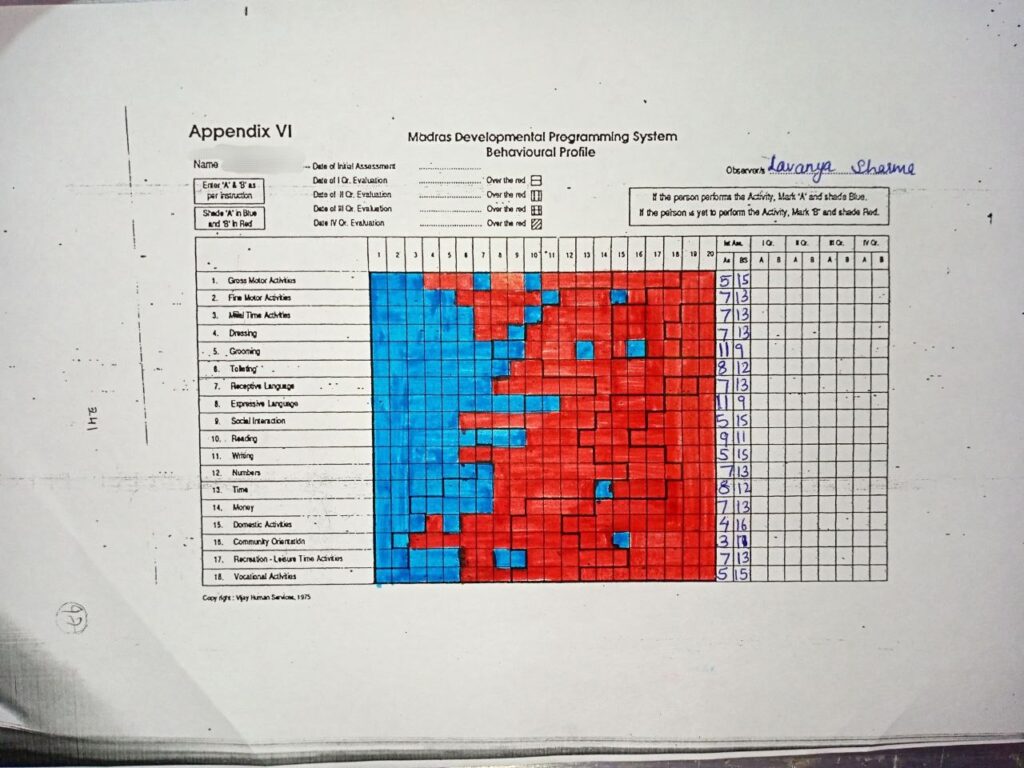
If the student performs the item, achievement is marked by “A”.
If the student fails to perform the item, failure is marked by “B”.
All theA and B are counted in each domain and entered at the right side column of the domain.
‘A’ colored with Blue and ‘B’ colored with Red.
The items student achieves is marked by ‘A’ and fails is marked by ‘B’
A’s are coloured with Blue. 🔵
B’s are coloured with Red. 🔴
The Blue 🔵 area indicates the students performance.
The Red 🔴 area indicates the needs to be given training.
Lavanya Sharma
Lavanya Sharma is a Special Educator, Author, and Inclusive Education Instructor with hands-on experience in supporting children with diverse abilities. Her work focuses on inclusive teaching strategies, teacher training, and empowering families to understand and support neurodiverse learners.