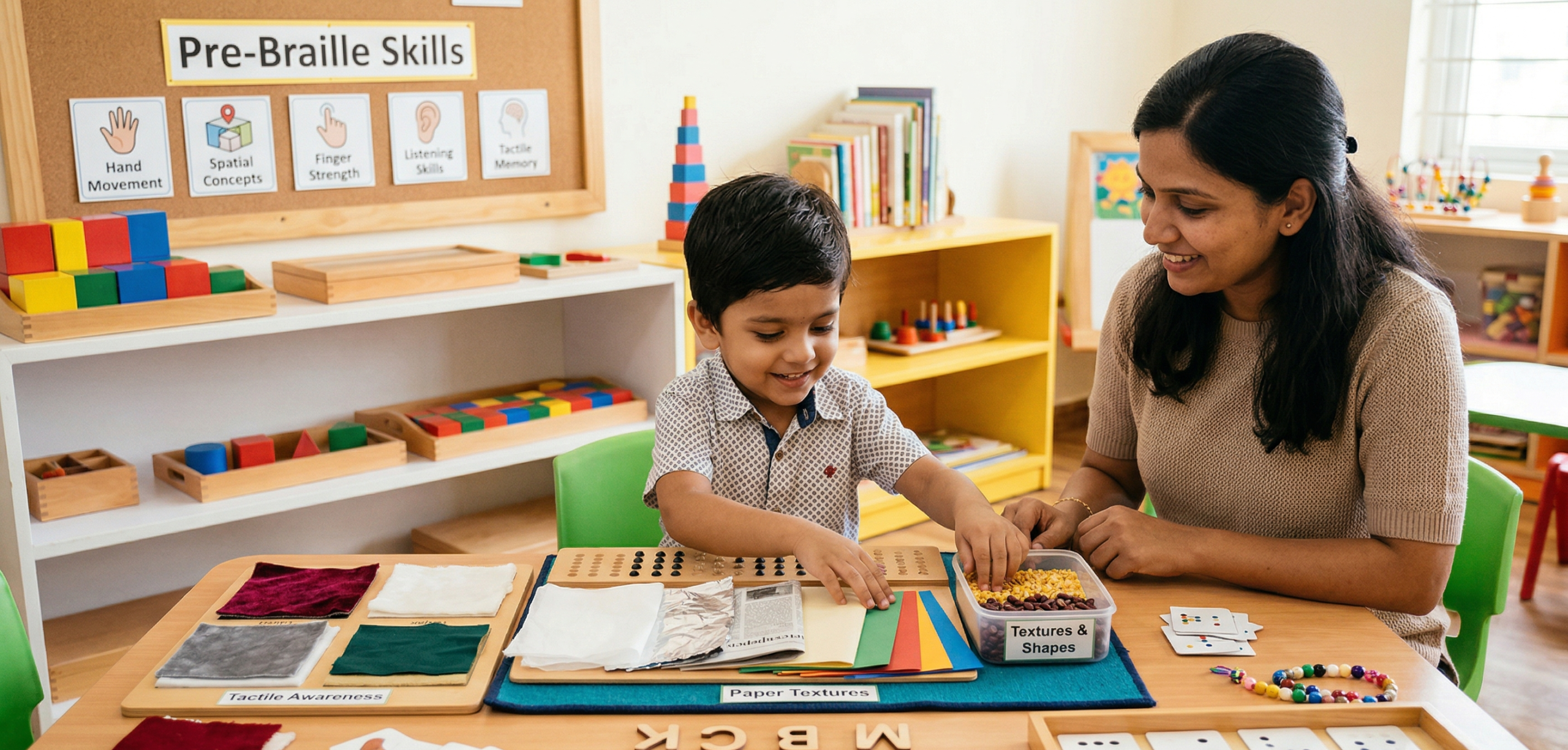
Pre-Braille skills are the foundational readiness skills that children need before they begin learning Braille reading and writing. These skills involve the development of tactile sensitivity, finger strength and coordination, hand movement, spatial and concept understanding, as well as attention, memory, and listening abilities. They enable the child to use their fingers efficiently, explore and discriminate through touch, understand directions and positions, and build the cognitive and sensory base required for successful Braille literacy.
Where Should We Focus?
Tactile Development
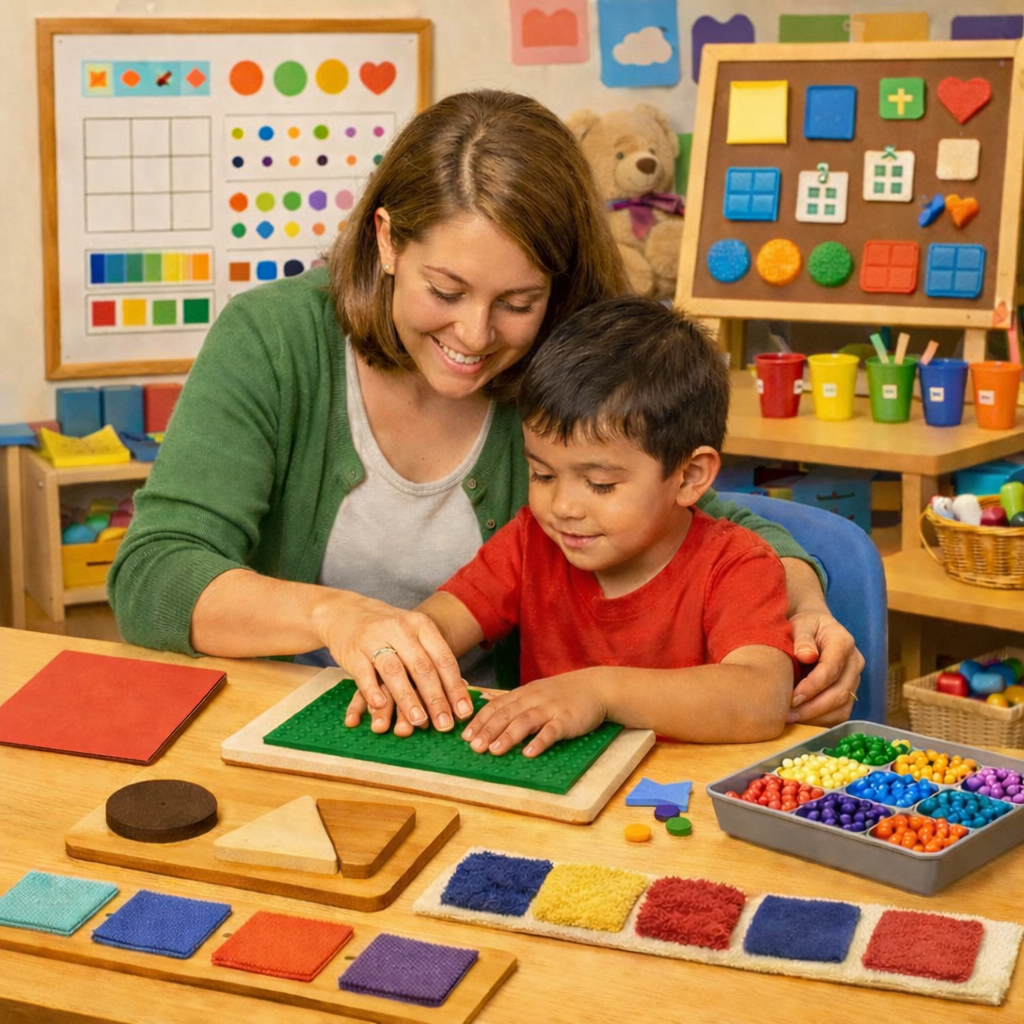
Tactile development is the foundation of Braille learning, as Braille is read through touch. Children need to become comfortable using their hands to explore their environment and should be able to feel, notice, and interpret differences through their fingertips. This includes tactile awareness, such as recognising different textures like soft, rough, smooth, and bumpy, and tactile discrimination, which involves identifying small differences between similar objects. Without proper tactile sensitivity, Braille dots may feel the same to the child, making reading difficult and ineffective.
Finger Strength & Fine Motor Skills
Finger strength and fine motor skills are essential for accurate and controlled finger movements required in Braille reading. Children need strong, flexible, and coordinated fingers to feel Braille dots clearly and continuously. Skills such as finger isolation (using one or two fingers independently), hand flexibility (smooth opening and closing movements), and bilateral coordination (using both hands together) are important. Weak or stiff fingers can reduce reading speed and accuracy, making it harder for children to develop fluency in Braille.
Hand Movement & Tracking
Hand movement and tracking prepare children for the actual process of Braille reading. Braille requires a smooth, continuous left-to-right movement using both hands, where one hand leads and the other supports. Children should learn to glide their fingers smoothly across surfaces without lifting them unnecessarily. Poor tracking skills may lead to skipping letters, losing place, or difficulty maintaining reading flow.
Concept & Spatial Understanding
Concept and spatial understanding help children interpret Braille meaningfully. Before learning symbols, children must understand basic concepts such as position (left, right, top, bottom, in, on, under), size, shape, and sequence. They should also understand order, such as beginning, middle, and end. Without these foundational concepts, children may struggle to attach meaning to Braille symbols and patterns.
Attention & Listening Skills
Attention and listening skills support learning and help children follow instructions effectively. Children need to develop sustained attention to stay focused on tasks, auditory processing to understand instructions and sounds, and memory to retain patterns and information. These skills are especially important for structured learning and classroom participation, particularly for children with developmental delays.
Tactile Memory
Tactile memory refers to the ability to remember what has been felt earlier. Children should be able to recall textures, shapes, or patterns they have explored through touch. This skill is important for recognising and differentiating Braille symbols repeatedly, which supports reading fluency over time.
Body Awareness & Orientation
Body awareness and orientation involve understanding one’s own body parts and directions such as left and right. This helps children develop proper hand use, directionality, and spatial understanding. It also supports correct positioning during Braille reading and writing tasks.
Developing Pre-Braille and Fine Motor Skills through Tactile Exploration
When we teach children pre-Braille and fine motor skills, our primary focus is on developing tactile awareness and finger sensitivity. This is done by providing the child with hands-on exposure to a variety of everyday materials.
1. Activity with Different Types of Papers (Skill Example)
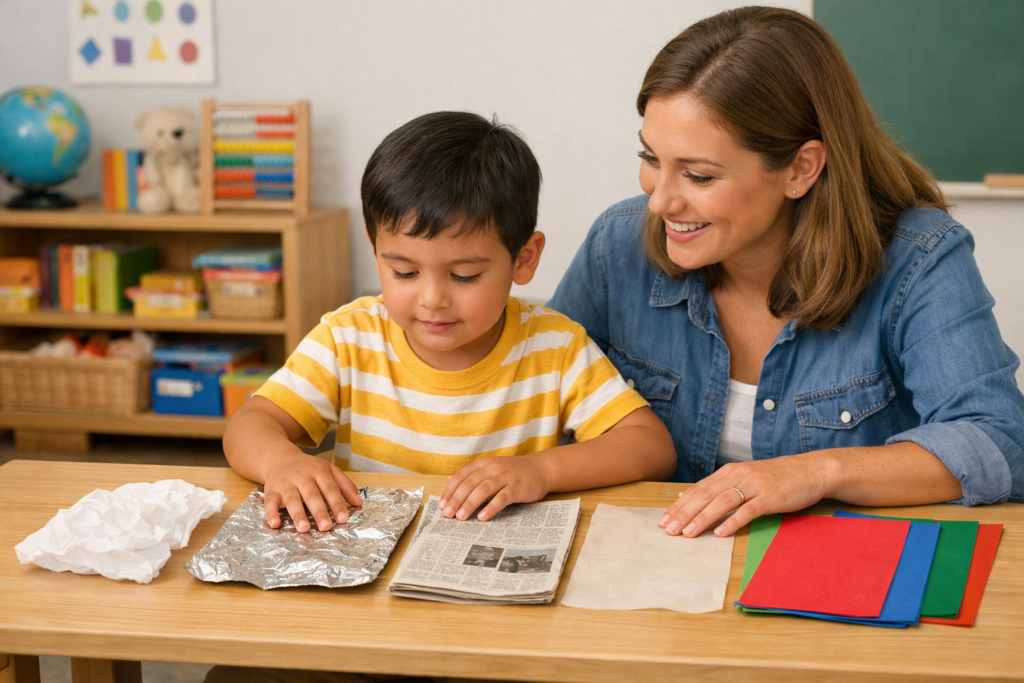
In this activity, we introduce the child to different types of papers with varied textures, such as:
- Tissue paper
- Foil paper
- Newspaper
- Butter paper
- Colored sheets
Procedure:
First, the child is allowed to freely touch, explore, and feel each type of paper. The teacher or parent may guide the child by describing the texture (e.g., soft, smooth, rough, thin, or shiny).
Once the child becomes familiar with these textures, we move to the next step—identification. The child is given one paper at a time and asked to recognize it through touch. For example:
- “Can you find the newspaper?”
- “Which one feels like foil paper?”
This helps in improving tactile discrimination, memory, and identification skills.
2. Providing Exposure to Different Materials
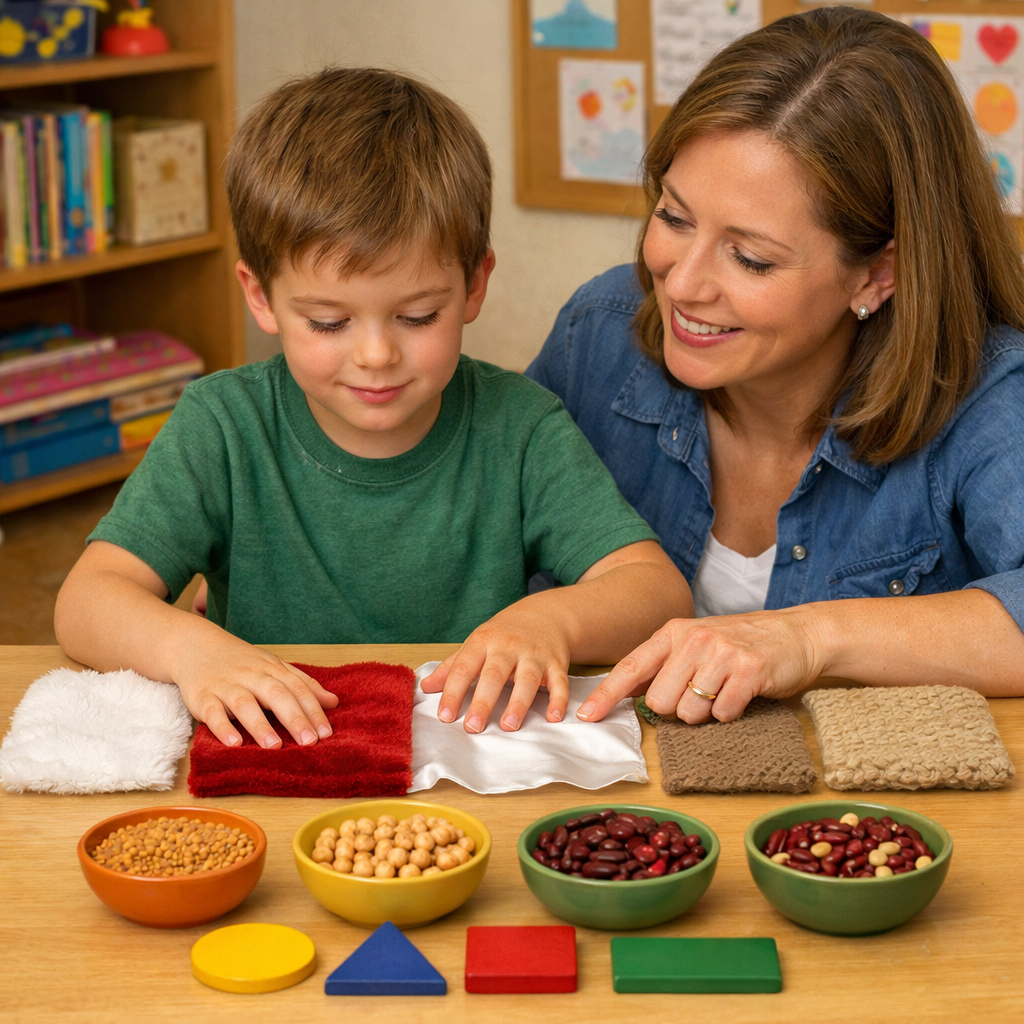
After introducing paper textures, we continue to provide exposure to a wide range of materials from daily life, such as:
- Different types of cloth (cotton, velvet, satin, wool, knit)
- Pulses (dal, chana dal, urad dal, kidney beans, chickpeas)
- Shapes (circle, triangle, square, rectangle)
- Textures and properties (soft, hard, long, short)
The process remains the same:
- Exploration – The child touches and feels the material
- Guided understanding – The adult explains the features
- Identification – The child identifies the object independently through touch
For example, after feeling different cloths, the child is asked,
“Which one is satin?” or “Can you find the cotton cloth?”
Similarly, with pulses, the child learns to differentiate between textures and sizes by identifying each item one by one.
3. Importance of This Approach
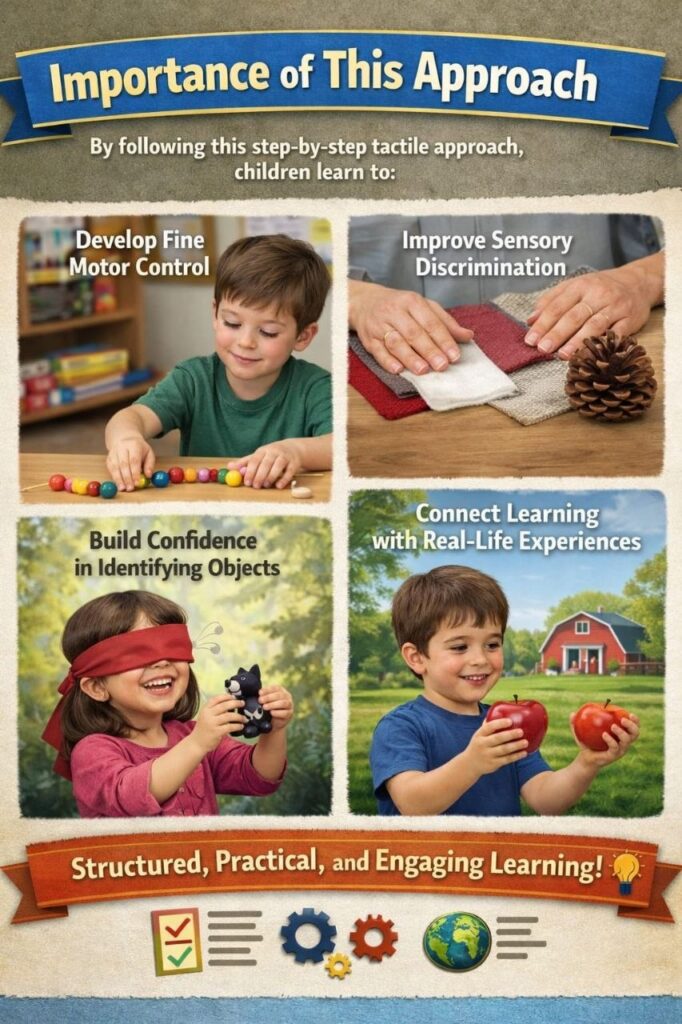
By following this step-by-step tactile approach, children learn to:
- Develop fine motor control
- Improve sensory discrimination
- Build confidence in identifying objects independently
- Connect learning with real-life experiences
This method ensures that learning is not only structured but also meaningful, practical, and engaging for the child.
Pre-Braille skills form the essential foundation for a child’s journey into Braille literacy. Before a child can read and write using Braille, they must first develop strong tactile awareness, fine motor control, hand coordination, and the ability to understand spatial concepts and directions. These foundational skills not only support accurate Braille reading but also make the learning process smoother and more meaningful.
By using simple, hands-on activities with everyday materials, children get the opportunity to explore, feel, and understand the world through touch. This step-by-step tactile approach helps improve sensory discrimination, strengthens finger movements, enhances memory, and builds confidence in independent identification.
Most importantly, this method connects learning with real-life experiences, making it engaging, practical, and effective. When children are given the right exposure and guidance early on, they develop the readiness and confidence needed to successfully transition into Braille reading and writing.