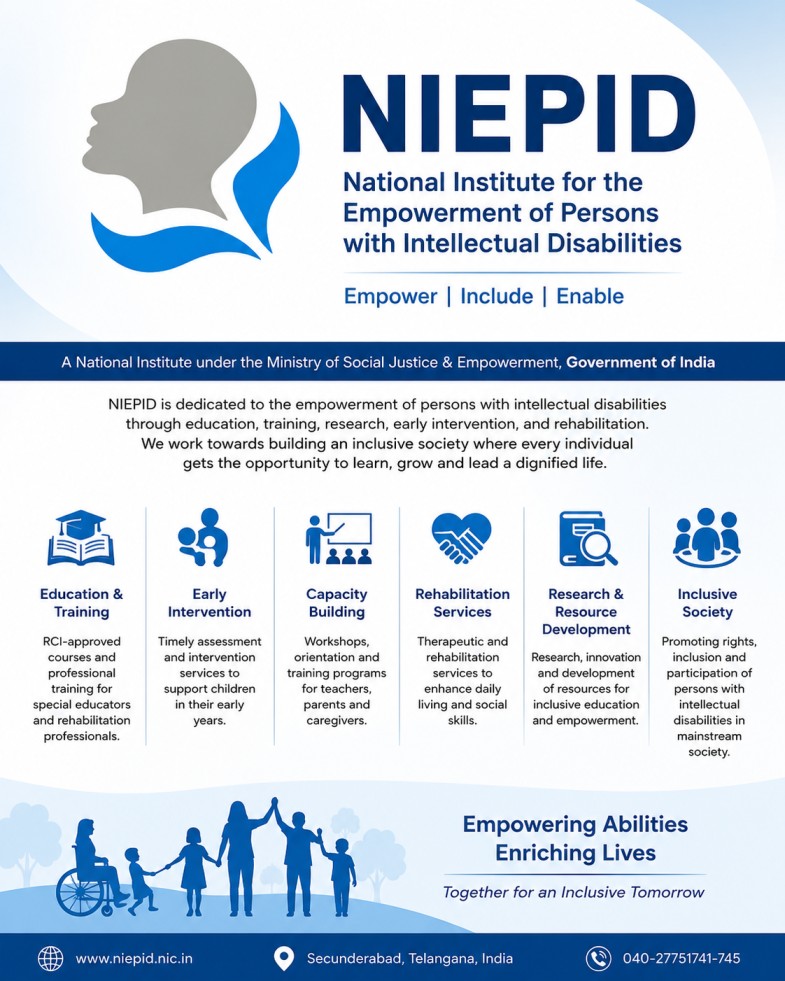
History of (NIMH to NIEPID)
The institute was originally established in 1984 as the National Institute for the Mentally Handicapped (NIMH) under the Ministry of Welfare, Government of India. Its main aim was to provide rehabilitation, education, training, and research services for persons with intellectual disabilities.
In 2015, the name was changed to National Institute for the Empowerment of Persons with Intellectual Disabilities (NIEPID) to adopt respectful and empowering terminology aligned with disability rights and inclusive practices in India. The change reflected a shift from a charity-based approach to a rights-based and empowerment-focused approach.
Major milestones include:
- Development of special education and rehabilitation programs
- Establishment of regional centers across India
- Teacher training and RCI-approved courses
- Parent guidance and community-based rehabilitation services
- Promotion of inclusive education policies
Official Website: https://niepid.nic.in/
Courses Offered for Special Educators by
NIEPID offers various diploma, degree, and certificate programs approved by the (RCI).
Popular courses include:
- D.Ed. Special Education (Intellectual Disability)
- B.Ed. Special Education (ID)
- M.Ed. Special Education
- Diploma in Early Childhood Special Education
- Certificate courses in rehabilitation and inclusive education
- Caregiver training programs
- Orientation courses for parents and teachers
The institute also conducts:
- Workshops
- Faculty development programs
- Online training
- Inclusive education training for general teachers
These courses prepare professionals for schools, therapy centers, rehabilitation settings, NGOs, and inclusive classrooms.
Role of in Inclusive Education in India
NIEPID plays a major role in promoting inclusive education by:
- Training special educators and general teachers
- Developing teaching-learning materials
- Conducting disability screening and assessment
- Supporting implementation of inclusive education policies
- Creating awareness among parents and communities
- Providing assistive devices and intervention strategies
The institute collaborates with:
- Schools
- Government departments
- NGOs
- Rehabilitation professionals
- Teacher training institutions
NIEPID also supports the implementation of:
- Inclusive classroom practices under the Indian education system
- Its work helps children with intellectual disabilities access education alongside their peers.
Early Intervention Services by
Early intervention services focus on identifying developmental delays at an early age and providing timely support.
Services include:
- Developmental screening
- Speech and language intervention
- Occupational therapy
- Physiotherapy
- Parent counseling
- Behavioral intervention
- Preschool readiness training
The institute emphasizes family participation and home-based intervention programs.
Benefits of early intervention:
- Better communication skills
- Improved social interaction
- Enhanced daily living skills
- Better school readiness
- Reduced developmental gaps
NIEPID also provides guidance for children with:
- Intellectual disability
- Autism spectrum disorder
- Developmental delay
- Multiple disabilities
How Supports Children with Intellectual Disabilities
NIEPID supports children through:
- Functional assessment
- Individualized educational planning
- Therapy services
- Vocational training
- Special education support
- Parent training
- Inclusive education support
- Community-based rehabilitation
The institute develops:
- Adapted teaching-learning materials
- Braille and accessible resources
- Skill-based curriculum
- Pre-vocational and vocational programs
It also works toward improving:
- Communication
- Social skills
- Self-help skills
- Academic functioning
- Independent living
Parent empowerment and teacher guidance are important parts of its rehabilitation model.
Career Opportunities After Special Education Courses
After completing RCI-approved special education courses, professionals can work as:
- Special educator
- Inclusive education resource teacher
- Early intervention educator
- Rehabilitation professional
- Shadow teacher
- Behavior trainer
- Skill trainer
- Therapy assistant
- Disability counselor
- Academic coordinator
Employment areas include:
- Government schools
- Special schools
- NGOs
- Rehabilitation centers
- Hospitals
- Inclusive schools
- Child development centers
- Private practice
- Online intervention platforms
Many professionals also:
- Create educational content
- Conduct workshops
- Develop teaching-learning materials
- Start therapy or learning support centers
Higher studies options include:
- M.Ed. Special Education
- M.Phil.
- Clinical psychology
- Speech-language pathology
- Occupational therapy
- Inclusive education research
Difference Between RCI-Approved Institutes in India
regulates rehabilitation and special education courses in India.
Key Differences Among RCI-Approved Institutes
| Feature | NIEPID | Other RCI Institutes |
|---|---|---|
| Focus Area | Intellectual disability | May focus on HI, VI, ASD, CP, or multiple disabilities |
| Government Status | National autonomous institute | Government/private/university-based |
| Training Programs | Extensive rehabilitation and teacher training | Varies by institution |
| Research Activities | Strong national-level research | Limited in some institutes |
| Regional Centers | Available across India | Depends on institute |
| Early Intervention Services | Comprehensive | Varies |
| National Policy Support | Strong government collaboration | Limited in smaller institutes |
Before joining any institute, students should verify:
- Course recognition
- RCI approval status
- Internship opportunities
- Faculty and infrastructure
- Placement support
Official RCI website: Rehabilitation Council of India